
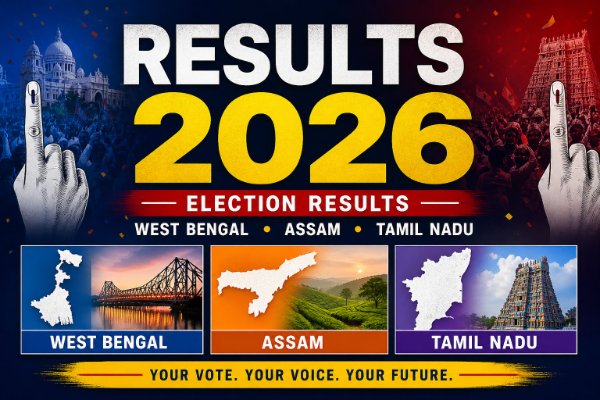
The results of the 2026 Assembly elections in West Bengal, Assam, and Tamil Nadu are shaping up to be one of the most significant political moments in recent years. What initially looked like a routine state election cycle has quickly turned into a larger story about shifting voter sentiment, new political forces, and changing power dynamics across India.
In West Bengal, the biggest headline is the scale of the shift. Early trends show the BJP crossing the majority mark and challenging what has been a long-standing Trinamool Congress stronghold. For over a decade, Bengal politics revolved around Mamata Banerjee and the TMC. This election, however, suggests that a large section of voters was ready to consider an alternative. The results are not just about seats; they signal a deeper change in how Bengal’s electorate is thinking about governance, identity, and development.
Assam, on the other hand, appears to be reinforcing continuity rather than change. The BJP is once again leading comfortably and looks set to secure another term. Unlike Bengal, where the story is about disruption, Assam’s outcome reflects consolidation. The party has managed to maintain its base and expand in key regions, showing that its political model in the state continues to resonate with voters.
Tamil Nadu is where the real surprise lies. Actor-turned-politician Vijay’s party, Tamilaga Vettri Kazhagam (TVK), has emerged as a serious contender and is leading in a large number of seats. This is a major disruption in a state that has traditionally been dominated by the DMK and AIADMK. The rise of a new political force here is not just about celebrity influence; it reflects a growing appetite among voters for alternatives outside the established Dravidian framework.
What makes these results particularly interesting is how different each state’s story is. In Bengal, it is about a possible power shift. In Assam, it is about stability and continuity. In Tamil Nadu, it is about the emergence of a new political player. Taken together, these outcomes point to a broader national trend. Voters are no longer tied as strongly to traditional loyalties. In some states, they are rewarding incumbents. In others, they are actively seeking change. This mix of continuity and disruption highlights how fragmented and dynamic the political landscape has become.
These elections also carry implications beyond the states themselves. Strong performances by national parties in regions where they were previously weak, and the rise of new regional forces, will inevitably shape political strategies going into future national elections. For now, one thing is clear. This is not just another election cycle. It is a reflection of a voter base that is more fluid, more demanding, and far less predictable than before.
Comments (0)
No comments yet.